# Process Omniverse – Why I Created This Category
This is a subtitle for your new post
Process Omniverse – Why I Created This Category
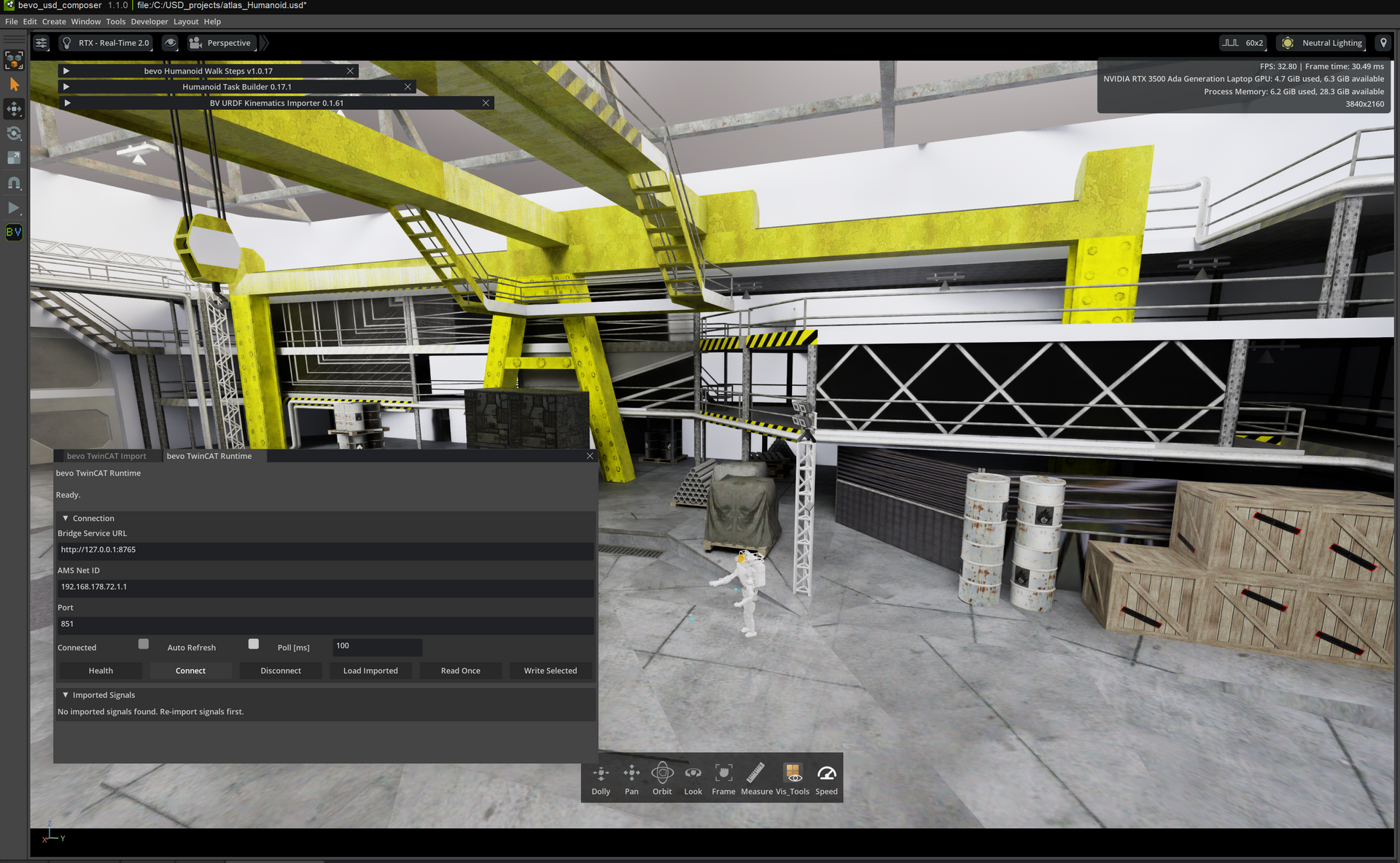
Over the last few years, I have spent a significant amount of time working with NVIDIA Omniverse and USD Composer. During that journey, a new category slowly emerged for me, which I eventually started calling “Process Omniverse.”
The term did not come from marketing, and it is not simply a new name for a few extensions. For me, it describes a gap that became very obvious once I moved from the traditional industrial simulation world into the world of NVIDIA Omniverse.
My background comes from automation technology, virtual commissioning, and industrial simulation. That means the way I look at software is heavily influenced by production systems, robotics, PLC logic, material flow, cycle times, plant behavior, and real industrial processes. When I think about simulation, I do not first think about beautiful camera animations or cinematic 3D scenes. I think about systems that must behave logically. Robots executing real programs. Signals exchanged between PLCs and simulation systems. Material moving through production lines. Processes that must be validated before the real plant even starts production.
That was exactly the mindset I brought with me when I started working with NVIDIA Omniverse and USD Composer.
At first, of course, the technology is impressive. The graphics are outstanding, RTX rendering looks fantastic, large CAD datasets can be visualized smoothly, and the USD format itself offers enormous flexibility. On top of that, there are concepts such as references, layers, modern material systems, textures, multi-user workflows, and realtime visualization. Technically, it is extremely fascinating.
But at the same time, you quickly realize something important:
USD Composer is not a traditional industrial simulation software.
And that distinction matters a lot.
USD itself originally came from Pixar. It was designed for large-scale 3D productions, complex scenes, animation pipelines, asset management, and cinematic workflows. And for those use cases, it is incredibly powerful.
Inside USD Composer, it is relatively easy to create high-quality animations. You can work with timelines, sequencers, keyframes, camera movements, object animations, and cinematic rendering workflows. Combined with RTX and path tracing, the visual quality becomes extremely impressive, with realistic materials, lighting, reflections, and shadows.
But animation is not the same thing as simulation.
That difference may sound small at first, but for industrial applications it is fundamental.
An animation simply shows that something moves. A simulation must explain why something moves, when it moves, which signal triggered it, whether the process logic is correct, and whether the behavior matches the real production system.
In classical industrial simulation, the focus is not only on movement. The focus is on material flow, cycle times, robot behavior, PLC communication, process logic, conveyor systems, signal states, timing, and complete production workflows.
A robot moving from point A to point B is not enough.
The real challenge is understanding whether the process itself behaves correctly.
Of course, NVIDIA also offers simulation technologies such as Isaac Sim or PhysX. And those technologies are extremely powerful for many use cases. But for someone coming from tools such as Siemens Process Simulate, Plant Simulation, Visual Components, or other industrial engineering platforms, the meaning of “simulation” is often very different.
Traditional industrial simulation is deeply process-oriented. It combines robotics, PLCs, logic, production behavior, safety concepts, sequencing, and real manufacturing processes into one complete virtual environment.
And that was exactly the point where the idea of Process Omniverse was born.
I started asking myself:
What kind of tools, extensions, workflows, and supporting systems are actually needed to bring true industrial process simulation into NVIDIA Omniverse?
Because from my perspective, this is where the real potential begins.
USD Composer already provides an incredibly strong technological foundation. It can handle huge worlds, modern rendering, realtime visualization, open data structures, references, streaming, APIs, extensions, and scalable scene management. But what is often missing for industrial users is the actual process layer.
And that process layer is exactly what Process Omniverse is about.
For me, Process Omniverse means treating Omniverse not only as a visualization platform, but as a foundation for real industrial workflows and process-driven simulation.
It is about connecting plant logic, robotics, material flow, PLC communication, user interaction, signals, movement systems, and industrial behavior models into one usable environment.
Because in industry, beautiful 3D data alone is simply not enough.
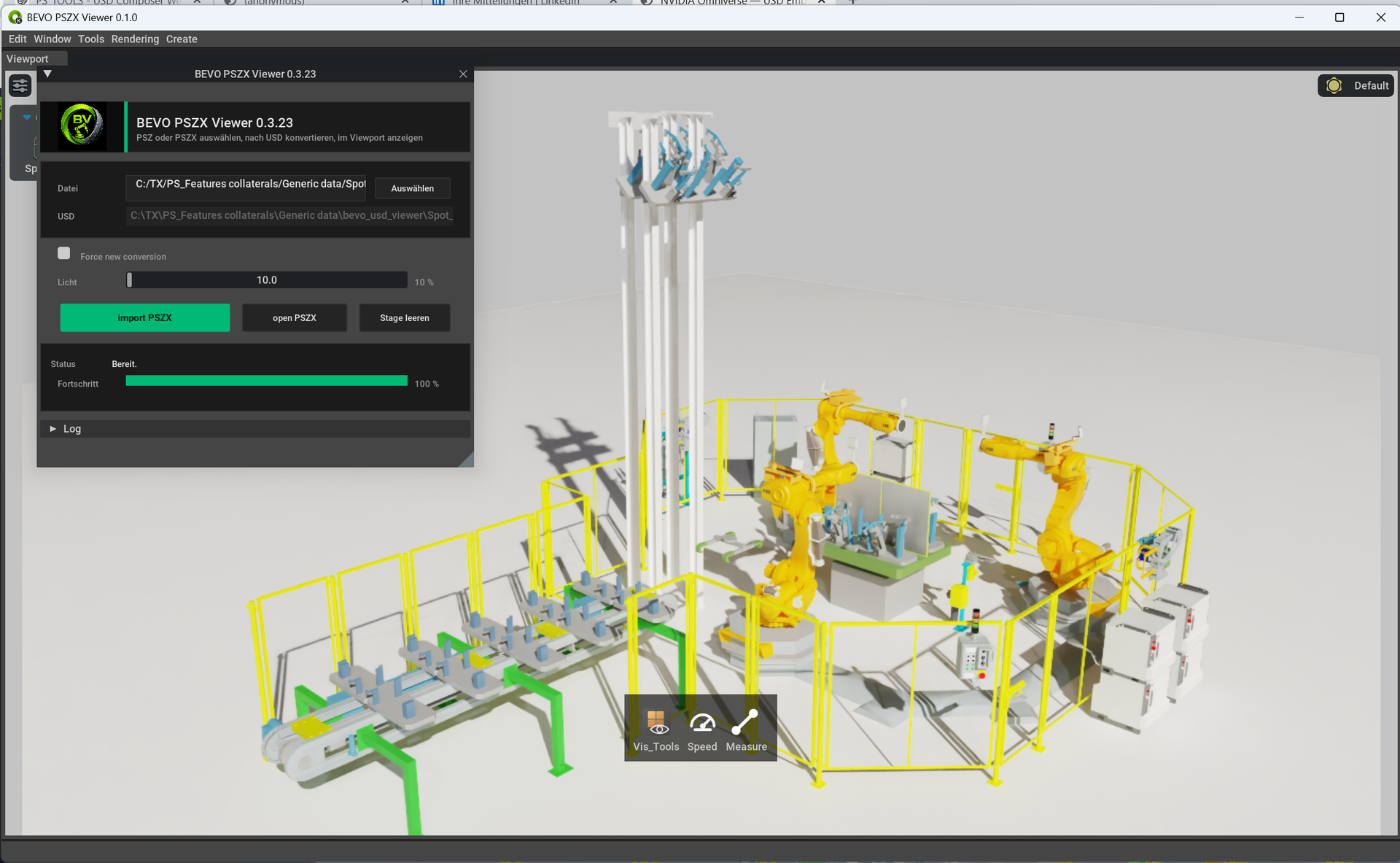
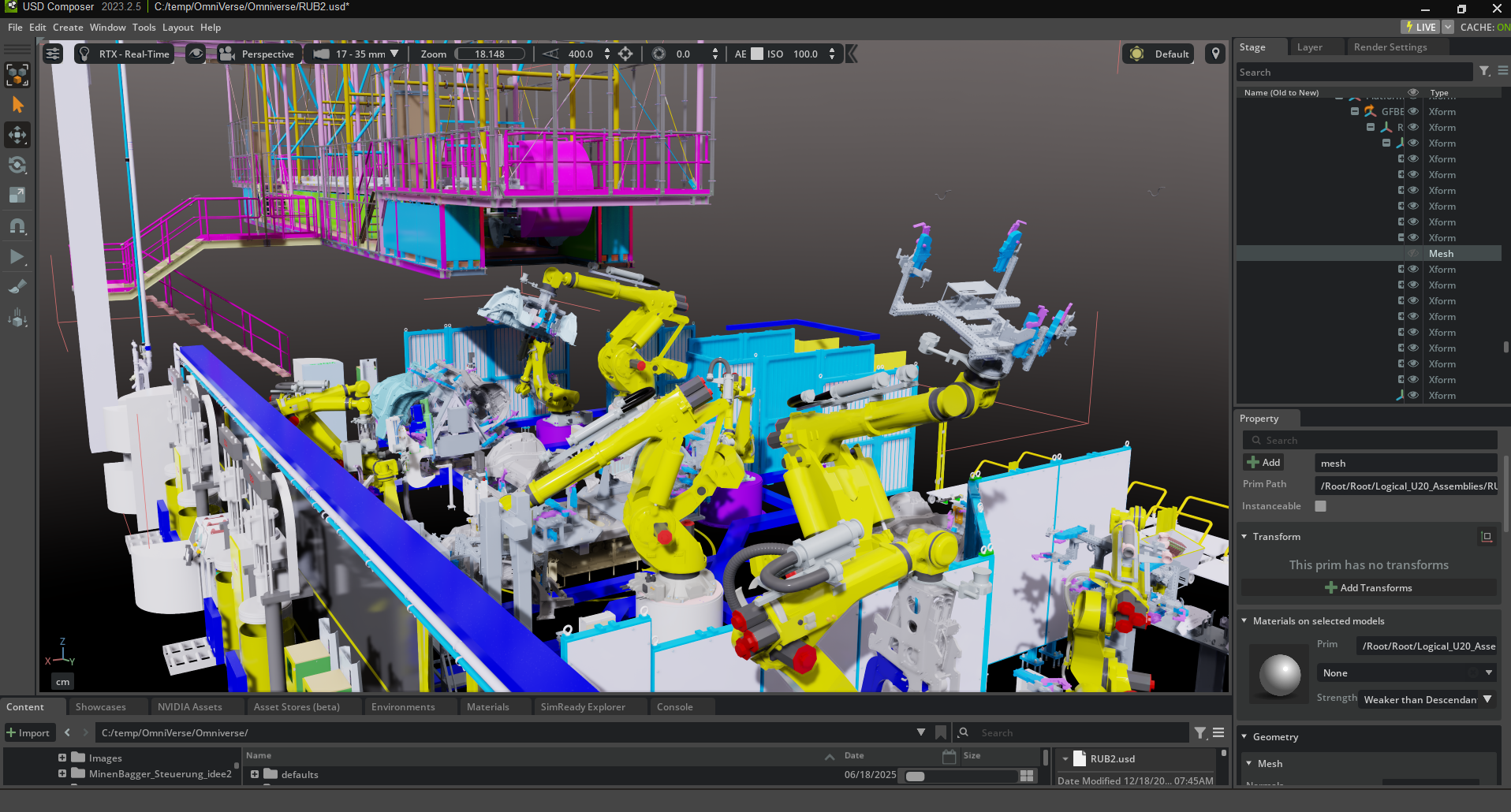
A factory scene inside USD Composer may look visually impressive. But the real value only appears once the factory actually behaves like a factory. Once conveyor systems transport material. Once robots execute workflows. Once signals influence real states. Once process logic controls behavior. Once users can interact with understandable industrial tools instead of simply looking at static geometry.
That is why Process Omniverse, for me, is not only about extensions.
It is also about know-how, workflow design, usability, automation, interfaces, industrial logic, process understanding, and user-oriented engineering.
Because in the end, industrial software is not successful simply because the technology works. It becomes successful when users can efficiently work with it and solve real industrial problems.
And that, in my opinion, is one of the biggest differences between a technical platform and a true industrial solution.
NVIDIA Omniverse already provides many of the technical building blocks. But these building blocks still need to be connected into meaningful industrial workflows. And that is exactly where I see the role of Process Omniverse: creating the bridge between traditional industrial simulation and modern technologies such as USD, RTX, realtime rendering, web streaming, multi-user collaboration, and open platform architectures.
Over the next months and years, I want to continue building and presenting different tools, extensions, workflows, and technical approaches under this category that help make industrial simulation possible inside NVIDIA Omniverse.
The goal is not to simply recreate existing simulation software one-to-one.
The goal is to combine the strengths of both worlds.
Traditional industrial simulation brings process understanding, virtual commissioning, production logic, and engineering methodology.
Omniverse brings modern visualization, scalable data structures, realtime graphics, openness, flexibility, and entirely new possibilities for the Industrial Metaverse.
And exactly at that intersection, I currently see one of the most exciting technology areas of all.
And that is exactly why Process Omniverse exists.