My Journey with Robcad Process Simulate
My Journey with Robcad and Process Simulate
When I look back today at topics such as virtual commissioning, robot simulation or Siemens Process Simulate, it is not just some kind of software or technical tool to me. It is much more a journey that now goes back more than 20 years and has shaped me both professionally and personally.
My first points of contact with automation technology in automotive manufacturing began back in 2003 at the company ATEC, which later became VESCON. The work there was about classical automation technology, plant commissioning, project management and many different topics around production systems in the automotive environment. In other words, exactly the world of PLCs, robotics, conveyor technology and plant control.
Back then, many things were much more “hands-on” than they are today. Digitalization was already a topic, but it was far from being as natural and established as it is today. Many things were tested, adjusted and optimized directly at the real plant. That is exactly why it was so exciting for me when I first came into contact with offline programming and robot simulation around 2008.
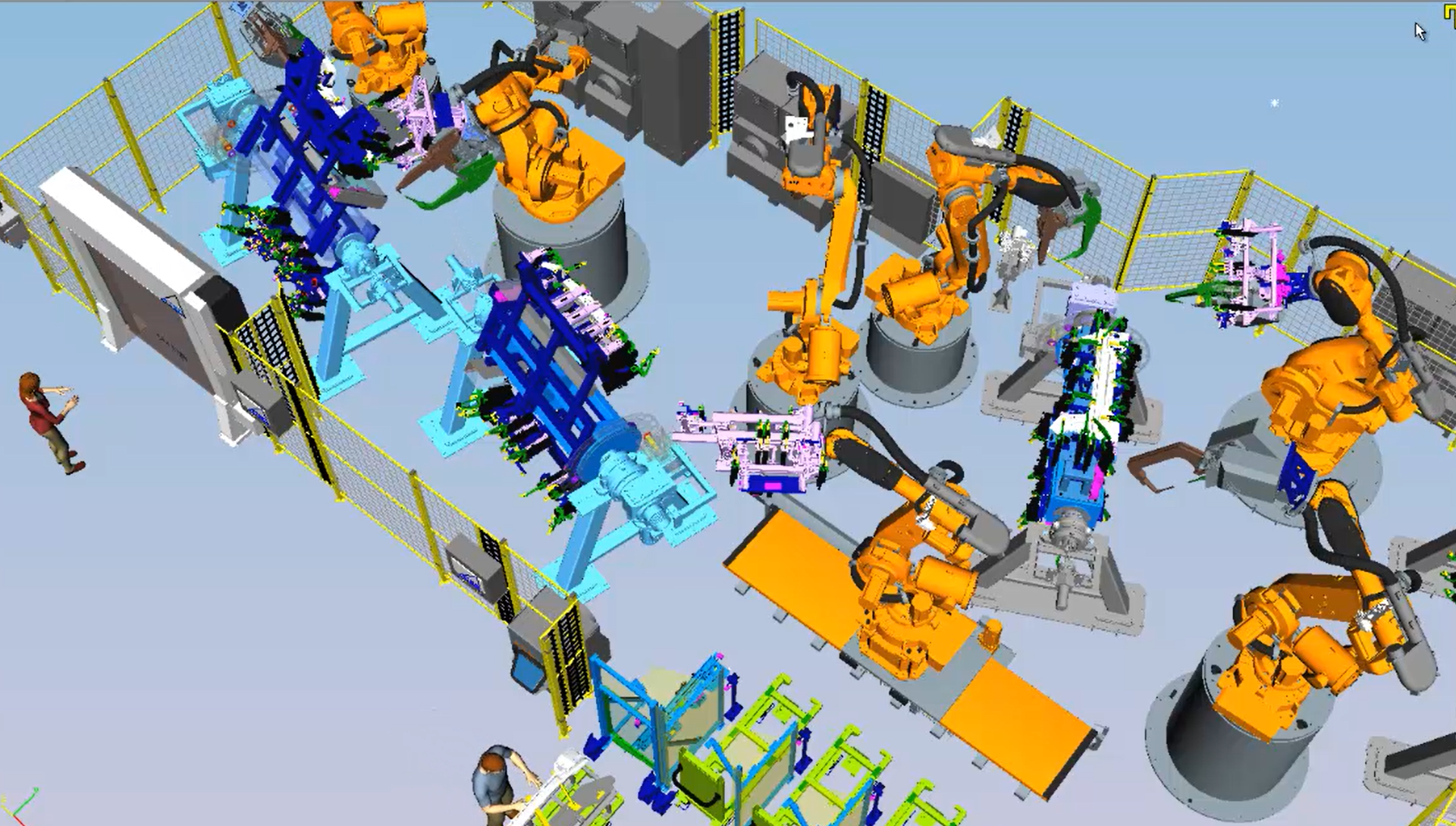
At that time, the first projects were running at Rolls-Royce, and through that there was the opportunity to look behind the scenes of robot simulation together with an engineering office. At that time it was still Siemens Robcad - long before it later became Siemens Process Simulate.
Even the hardware back then was impressive. Robcad ran on SGI workstations, those large blue high-end CAD machines that were incredibly expensive at the time. These systems alone already had something special about them. This was not ordinary office hardware, but specialized high-end technology for CAD and simulation.
The first robot simulations in Robcad then ran on these SGI workstations. For me, that was absolutely fascinating at the time. Suddenly it was possible to simulate complete robot movements in 3D, create programs offline and virtually test entire sequences. Things that feel almost self-evident today were technically extremely impressive back then.
At the beginning of 2009, I was finally able to install Robcad myself for the first time and really use it actively. And that was where my real journey into virtual robot simulation actually began.
The problem back then was: there was hardly any information. Today you open YouTube, watch tutorials or read through hundreds of forum posts. Back then, it was completely different. Robcad was highly specialized software. Documentation was difficult to find, experts were extremely rare and much of the information was only available through projects or contacts with other companies.
That is why a huge part of my work back then consisted simply of testing.
At ATEC, we had a small KUKA KR3 robot standing in the office. And that small robot basically became my personal test system. I started adding the robot in Robcad, modeling the gripper and creating my first offline robot programs.
That may sound trivial today, but at the time it was incredibly exciting to me.
I was able to create programs in Robcad, transfer them to the real robot afterwards and then observe how the robot suddenly executed real movements that had been created completely virtually beforehand. In some cases, we let the robot grip simple things or draw with a pen. Afterwards, the programs were loaded back into Robcad and further analyzed or adjusted there.
And that was where my real enthusiasm for virtual commissioning and simulation began.
In 2009, I really invested every free minute into this topic. I tried out all kinds of things in Robcad, searched for documentation, watched videos and simply tested. You have to remember: back then YouTube was nowhere near as full of specialist content as it is today. Especially in the field of robot simulation, there was hardly any public knowledge.
At some point I realized that Siemens had already released the successor to Robcad: Siemens Process Simulate in version 8.2. And at that moment I thought to myself: “Okay, now I will stop looking at the old Robcad stuff and move directly into the new topic of Process Simulate.”
Fortunately, we already had the corresponding licenses at ATEC, so I was able to install and test Process Simulate quite quickly. What was interesting back then was that many people were still fully working with Robcad, while I had already started to deal intensively with Process Simulate. That meant I was relatively early with this system.
In addition, I was lucky that, through various projects - for example at Rolls-Royce or BMW Leipzig - we repeatedly had points of contact with offline programming and virtual commissioning. They were not directly our own OLP projects, but it was possible to get a glimpse, try things out and observe how other companies were already using these technologies.
Because I originally come from automation technology and am a trained automation technician, my focus was never only on the robot itself. I was much more interested in the entire topic of virtual commissioning.
Questions such as:
How do you connect a PLC?
How do you model plant behavior?
How do interfaces work?
How do you simulate complete production processes?
For me, the robot was actually only one part of the overall system.
In 2009, we then had a project at BMW Leipzig where we had to, or rather were allowed to, carry out the plant commissioning. And that was exactly where I thought: “Now you try the whole thing with Process Simulate.”
Back then, I converted the existing Robcad data into Process Simulate and started building a full virtual commissioning setup. That was in fact my first large VIBN project in Siemens Process Simulate.
We had a Siemens S7-400 PLC, several ABB robots, offline programs, behavior models inside Process Simulate and a complete PLC connection. And when I think about it today, it is actually crazy. We are talking about 2009 and Process Simulate version 8.2. Back then, virtual commissioning was nowhere near as widespread as it is today. Many things were experimental, a lot had to be figured out by yourself and often there were no clear procedures.
But that was exactly what made it so exciting back then.
From there, things continued over the years. I carried out many different virtual commissioning projects for different manufacturers, standards and special-purpose machines. Always new PLC systems, new interfaces, new plant concepts and new challenges.
At some point - I think from around 2014 - it became increasingly clear that professional virtual commissioning requires many supporting tools. Whether inside or outside Process Simulate: without automation, you eventually become too slow in large projects.
That was where the first custom tools began.
Together with colleagues, we started developing our own applications in C#. The goal was to automate typical processes and build complete VIBN projects faster. This included, for example, signal imports, automatic signal assignments, separate viewers and various support tools for virtual commissioning.
The idea was always the same:
You receive CAD data, signal lists and process descriptions - and as quickly as possible, this should become a runnable VIBN project so that testing can start early.
So we started developing more and more of our own tools for ourselves, allowing us to become faster, more efficient and better in projects.
And I think there is one project I will probably remember for the rest of my life.
I no longer remember exactly whether it was Christmas 2015 or 2016, but we carried out a virtual commissioning project for a Rolls-Royce plant back then. The plant had around twelve KUKA robots. At first, that may not sound that spectacular. But the real dimension was somewhere else.
The plant had a cycle time of around 45 minutes.
That means it took 45 minutes until a vehicle, or a part of the vehicle, had passed through the entire plant. The robots had an incredible number of sequences, tool changes, docking stations and complex process steps. The entire plant was huge.
And that was exactly where we carried out the complete virtual commissioning together over Christmas.
It was stressful, extremely demanding and at the same time an incredibly exciting time. There, we really tried to get everything out of Process Simulate that was technically possible.
To this day, it is probably one of the projects I remember most strongly.
At some point, someone once told me that Process Simulate basically has three levels.
At the bottom starts the classic simulation.
Above that comes offline programming.
And at the very top is virtual commissioning.
Virtual commissioning is basically the supreme discipline.
Because that is where all areas suddenly come together:
Robotics,
PLC,
electrical engineering,
sequence control,
signals,
interfaces,
behavior models,
safety technology
and real production logic.
And that is exactly where the devil is in the details.
Many people do not understand that virtual commissioning requires an incredible number of things to be prepared already. You need finished PLC programs from the PLC programmer, finished robot programs from the robot programmer, prepared electrical engineering, EPLAN data, signal lists and clear sequences.
Only when this information is available early can it also be tested virtually.
And that changed many projects massively over the years.
Suddenly, virtual commissioning was no longer just some additional step, but a real driver within projects. People would sometimes jokingly say: “That annoying VIBN is causing stress again.” But actually, the reason behind it was different: virtual commissioning simply requires information much earlier so that problems can already be detected in the virtual world.
And that suddenly increased the requirements for data quality, project preparation and coordination enormously.
Over the years, virtual commissioning then established itself almost everywhere - whether driven by the customer or by the supplier. Improving quality, saving time, detecting errors early and securing plants faster became more and more important.
And when I look back today, it is crazy to see how Process Simulate has developed over the years.
From version 8.2 through 9, 10, 11, 12, 13 and up to today’s version 26.06, there are simply technical worlds in between. The possibilities, interfaces and functions today are enormous.
Still, I often like to think back to those early days. Because that is where the foundation was actually created for everything I do today in the field of virtual commissioning, simulation and industrial digitalization.
Yours, Ben Voelzke